By Hans Christian Andersen

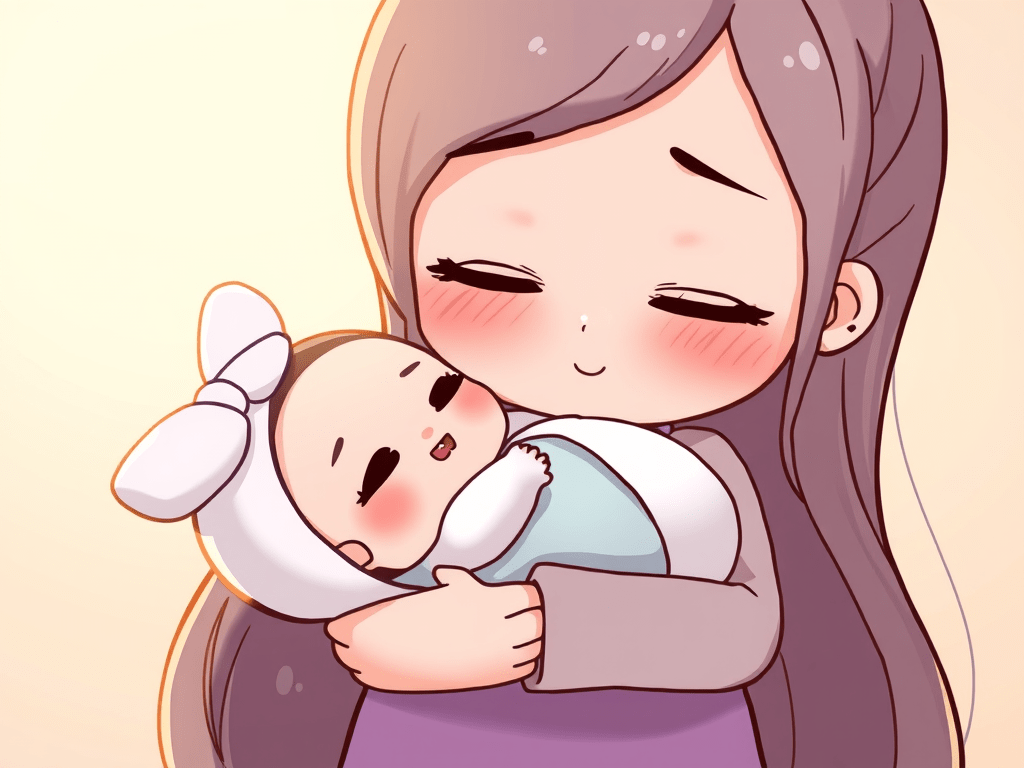
A mother was sitting by her little child; she was very sad, for she was afraid that it was going to die. Its little face was pale, and the little eyes were closed. The child breathed with difficulty, and at times as deeply as if it were sighing, and the mother looked more and more sadly at the little being. There was a knock at the door, and a poor old man came in wrapped up in a large horse-cloth to keep him warm; he had need of it, too, for it was in the depth of winter. Outside every thing was covered with ice and snow, and the wind blew so keenly that it cut one’s face.
As the old man was shivering with cold and the child was asleep for a moment, the woman got up and warmed some beer in the oven in a little pot. The old man sat down and rocked the cradle, while the mother also sat down on an old chair next to him, looking at her sick child, who was breathing so heavily, and holding his little hand.
“You don’t think I am going to lose it, do you?” she asked. “Heaven will not take it from me.”
The old man—it was
Death—nodded his head in such a strange way that it might just as well have meant
“Yes” as “No.” The mother looked down and tears rolled over her cheeks. Her head began to feel heavy; for three days and three nights she had not closed her eyes, and
now she slept, but only for a minute; then she jumped up shivering with cold.
“What is it?” she asked, looking all around her; but the old man was gone and her little child too. He had taken it with him. The wheels of the old clock in the corner went whirring round; the heavy leaden weight ran right down to the
ground, and then the clock stood still.
The poor mother rushed out of the house, calling for her child.
Outside, in the midst of the snow, sat a woman in long black clothes, who said: “Death has been in your room; I saw him hurry away with your little child. He strides along more quickly than the wind, and never brings back
what he has taken.”
“Only tell me which way he went,” said the mother. “Tell me the way, and
I will find him.”
“I know the way,” said the woman in black; “but before I tell it you, you must sing me all the songs you sung to your child. I like those songs; I have heard them before, for I am Night, and saw your tears when you were singing them.”
“I will sing them all—-all!” said the mother. “But do not detain me now;
let me overtake him, so that I may get my child back.”
But Night sat dumb and motionless. The mother wrung her hands, sing. ing and weeping. There were many songs, but still more tears. Then Night said: “Go to the right into the dark pine forest; thither I saw Death wend his way with the little child.”
In the depths of the forest the road divided, and she did not know in which direction to go. There stood a blackthorn bush, without any leaves, or flowers; for it was winter time, and icicles hung from its boughs.
“Have you seen Death pass by with my little child?”
“Yes,” replied the blackthorn bush; “but I shall not tell you which road he took unless you first warm me at your bosom. I am freezing to death here-I am turning into pure ice!”
So she pressed the blackthorn bush close to her bosom in order to thaw it completely. The thorns pierced her flesh and her blood flowed in large drops.
But the blackthorn bush put forth fresh green leaves and blossomed in the cold winter’s night; so warm is the heart of a sorrowing mother. Then the bush told her which road she was to take.
She came to a great lake upon which there was neither ship nor boat.
The lake was not frozen hard enough to bear her, nor was it shallow and even enough for her to wade through it, and yet she must cross it if she wished to find her child. Then she lay down to drink the lake dry, but that was impossible for one person to do. The sorrowing mother, however, thought that perhaps a miracle might be wrought.
“No, that will never do,” said the lake. “Let us rather see whether we can come to some agreement. I love to collect pearls, and your eyes are two of the brightest I have ever seen; if you will weep them out into me, I will carry you over to the great hothouse where Death lives and where he grows flowers and trees, each one of which is a human life.”
“Oh, what would I not give to get back my child!” said the sobbing mother. She wept still more, and her eyes fell down to the bottom of the lake and became two costly pearls. Then the lake took her up as though she were sitting in a swing, and in one sweep wafted her to the opposite shore, where stood a wonderful house, miles in length. It was difficult to say whether it was a mountain with forests and caves, or whether it had been built. But the poor mother could not see it; she had cried out her eyes.
“Where shall I find Death, who took my little child away?” she asked.
“He has not arrived here yet,”
said an old gray-haired woman, who was
walking to and fro and guarding Death’s hothouse. “But how did you find your way here, and who helped you?”
“Heaven has helped me,” she answered. “It is merciful, and that you will
be too. Where shall I find my little child?”
“I don’t know it,” said the old woman, “and you can’t see. Many flowers and trees have faded during the night, and Death will soon come to transplant them. You know very well that every human being has his tree of life or his flower of life, according to how it has been arranged for each. They look just like other plants, but their hearts beat. Children’s hearts can beat too. If you try, perhaps you may be able to recognize the heartbeat of your child. But what will you give me if I tell you what else you must do?”
“I have nothing to give,” said the unhappy mother. “But I will go to the
end of the world for you.”
“I have nothing there for you to do,” said the old woman; “but you can give me your long black hair: I daresay you know yourself that it is beautiful; it pleases me. You can have my white locks for it; they are better than nothing.”
“Is that all you want?” she said. “I will give you that with pleasure.” And she gave her her beautiful hair, receiving for it the snow-white locks of the old woman.
Then they went into Death’s great hothouse, where flowers and trees grew strangely intermingled. Here stood some delicate hyacinths under glass bells, and great strong peonies. There grew water-plants, some quite fresh, others somewhat sickly; water-snakes lay upon them, and black crabs clung fast to the stalks. In another place were splendid palm-trees, oaks, and plantains, parsley and blooming thyme. All the trees and flowers bore names; each
human life, and the people they represented were still living, some in China, others in Greenland, and all over the world. There were great trees planted in small pots, so that they were cramped and almost bursting the pots; and there was also many a weakly little flower set in rich mold, with moss all round it, and well taken care of and tended. The anxious mother bent down over all the little plants to hear the human heart beating in each, and from among millions she recognized that of her child.
“There it is!” she cried, and stretched out her hand towards a little crocus, which was feebly hanging over on one side.
“Don’t touch the flower!” said the old woman, “but stand here, and when Death comes—I expect him every moment-don’t let him tear up the plant, but threaten him that you will do the same with the other flowers: that will frighten him! He is responsible for them to Heaven; not one may be pulled up before permission has been given.”
Suddenly an icy blast swept through the hall, and the blind mother felt
that it was Death who was approaching
“How could you find the way here?” he asked. “How were you able to
come here more quickly than I?”
“I am a mother!” she replied.
Death stretched out his long hand towards the small delicate flower; but she held her hands firmly round it, held them clasped-oh! so closely, and yet full of anxious care lest she should touch one of the petals. Then Death breathed upon her hands, and she felt that this was colder than the cold wind; and her hands sank down powerless.
“You have no power to resist me!” said Death.
“But Heaven has!” said she.
“I only do its will,” said Death. “I am its gardener. I take up all its flowers and trees and transplant them into the great Garden of Paradise, into the Unknown Land. How they thrive there and what that life is like I may not tell you.”
“Give me back my child!” said the mother, weeping and imploring.
Suddenly she grasped two pretty flowers firmly in her hands and called
out to Death: “I will tear up all your flowers, for I am in despair.”
“Do not touch them!” said Death. “You say that you are so unhappy, and would you now make another mother as unhappy as yourself?”
“Another mother!” exclaimed the poor mother, and immediately let both
flowers go.
“Here are your eyes,” said Death. “I fished them up out of the lake; they were sparkling brightly at the bottom; I did not know that they were yours.
Take them back-they are now even brighter than before-and then look down into this deep well. I will utter the names of the two flowers you were about to tear up, and you will see what you were on the point of destroying.” She looked down into the well; it was a glorious thing to see how one of the lives became a blessing to the world, to see how much happiness and joy diffused itself around it. She also saw the life of the other, which consisted in sorrow and want, trouble and misery.
“Both are the will of God!” said Death.
“Which of them is the flower of unhappiness, and which the blessed
one?” she asked.
“That I will not tell you,” answered Death; “but this you shall learn from me, that one of the flowers is that of your own child. It was the fate of your child that you saw—the future of your own child.”
Then the mother shrieked with terror. “Which of them is that of my child? Tell me that! Liberate the innocent child! Release my child from all this misery! Rather take it away! Take it to the Kingdom of God! Forget my tears, forget my entreaties and all that I have done!”
“I don’t understand you,” said Death. “Will you have your child back, or shall I take it to that place that you do not know?”
Then the mother wrung her hands, and falling on her knees, prayed to the good God: “Hear me not when I pray contrary to Thy will, for Thy will is ever best! Hear me not! Hear me not!”
Her head sank down upon her breast, and Death went with her child to the Unknown Land.
 Fairytales Archive
Leave a comment